How to ace math: 8 things that actually work
Short answer To ace math, know every formula and where it comes from, keep a formula sheet beside you while you practise, work through every type of problem, and use materials that skip no step. Revise more than once, get help with the details, and explain each topic to someone else.
I have taught maths in a classroom and one to one for years, and the students who get top marks rarely have a special gift. They have habits. Here is how to ace math: the eight habits that make the most difference. The last one surprises most students.
1. Know every formula, and where it comes from
Formulas are the vocabulary of maths: you cannot hold a conversation without words, and you cannot solve a problem without them. So learn them. But derive each one once, on paper, by yourself, the way the special angles lesson rebuilds a whole table from two triangles. A formula you have built is one you can rebuild when your memory goes blank in an exam, and you will know exactly when it applies.
2. Keep a formula sheet in front of you while you practise
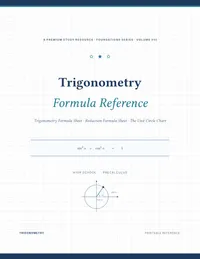
When you practise, have every formula of the topic on one page beside you. You stop losing minutes searching through notes, and the formulas you keep glancing at are the ones that stick. For trigonometry, the ACE MATH formula sheet is free: nine printable pages, no sign-up.
3. Work through every type of problem
An exam is built from a surprisingly small number of problem types. Make a list of them for your topic and solve at least one of each, then one more. When nothing on the paper is the first time you see it, the exam turns into recognising, not inventing.
4. Use materials that skip no step
Most textbooks jump from line two to line five and leave you to guess what happened in between. That gap is where students get stuck and give up. Look for worked examples where every step is written out and explained, and nothing is taken for granted. That is exactly why I write the ACE MATH study guides the way I do: every line of the working, the way a teacher writes it on the board.
5. Revise, then revise again
One pass through a topic is not learning it. Come back after a day, then after a week, then after a month. Each return is quicker than the last, and each one makes the topic stay longer. A short, regular revision beats one long night before the exam.
6. Let Gemini Notebook explain the details
My personal recommendation, from my own experience and not a paid one: Google’s Gemini Notebook (formerly NotebookLM). Upload your notes or a chapter and ask about any line you do not follow. It explains every detail, as many times and in as many ways as you need, and it answers from the material you gave it. Use it to understand, not to skip the thinking: the working still has to be yours.
7. Find a good mentor or tutor
Nothing replaces a person who watches you solve a problem, sees exactly where you go wrong, and shows you why. A good mentor or tutor is the biggest advantage a student can have. If you can, find one. Even a few sessions before an exam change how you work.
8. Explain it to someone else
This is the one that surprises people. Once you think you understand a topic, explain it out loud to someone: a friend, a sibling, or an empty chair. Explaining forces you to fill every gap you did not know you had, and what you have explained once, you remember far longer than what you have only read.
In short
Know the formulas and keep them in front of you. Practise every type of problem from materials that skip no step. Revise, and get help with the details, from Gemini Notebook or a good tutor. Then explain it to someone else. Do that, and you will not just pass the exam. You will ace it.
Frequently asked questions
Do you need a talent for math to ace it?
No. The students who get top marks rarely have a special gift; they have habits. Every habit on this page can be learned.
What is the best way to prepare for a math exam?
Make a list of the problem types in the topic and solve at least one of each, with every formula on one page beside you. Then check every step against a fully worked solution, and explain the hardest problem out loud.
How early should I start revising for a math exam?
Early enough to go through each topic more than once: come back to it after a day, after a week and after a month. A short, regular revision beats one long night before the exam.
What is ACE MATH?
ACE MATH is my series of printable math study guides: twenty volumes, from high school algebra to university calculus, with every step of every example written out. They are in the shop, and the free lessons are written the same way.